When a streaming platform enters a new market under New Zealand’s open GATS commitments, it acquires the right to supply audiovisual services. What it does not acquire is the content. The distinction between the right to supply and the IP rights needed to supply is the defining feature of trade in audiovisual and streaming services. In practice, the two are interconnected: a services commitment may open the market, but IP rights determine what can actually be shown, licensed and monetised within it. The reverse is also true. Rights are only commercially useful when the services framework allows them to be exercised at scale, so the services layer and the IP layer shape each other continuously.
1. Audiovisual Services in New Zealand’s Trade
New Zealand’s GATS commitments for audiovisual services — sector 2(D) in the W/120 classification — are more open than those of many WTO members, which commonly maintain cultural exception reservations. New Zealand imposes no limitations on Mode 1 or Mode 3 (commercial presence) for audiovisual services.
As the data illustrates, firms in audiovisual and media sectors place substantially higher weight on copyright protection than the wider economy — reflecting that creative output (films, scripts, music, performances) is where the value is, and copyright is the primary legal vehicle for holding and licensing it.[1]
The dominance of copyright throughout the series reflects the sector's character. Creative output is the product, and copyright is the main legal basis for controlling and licensing it. The high "no IP protection" share is best read as a business-practice signal: many firms may not be using extra protection steps in a visible way, especially for community content, live performance, or lower-profile works. It does not necessarily mean the underlying works have no legal protection.
This is the practical gap the paper tracks: firms may be legally protected, but market outcomes still depend on how rights are identified, bundled and licensed in day-to-day operations. The next section uses the IP-Services Toolkit to show where those rights sit in the audiovisual value chain, and why trade openness alone does not resolve rights-clearance frictions.
2. What the IP–Services Toolkit Shows
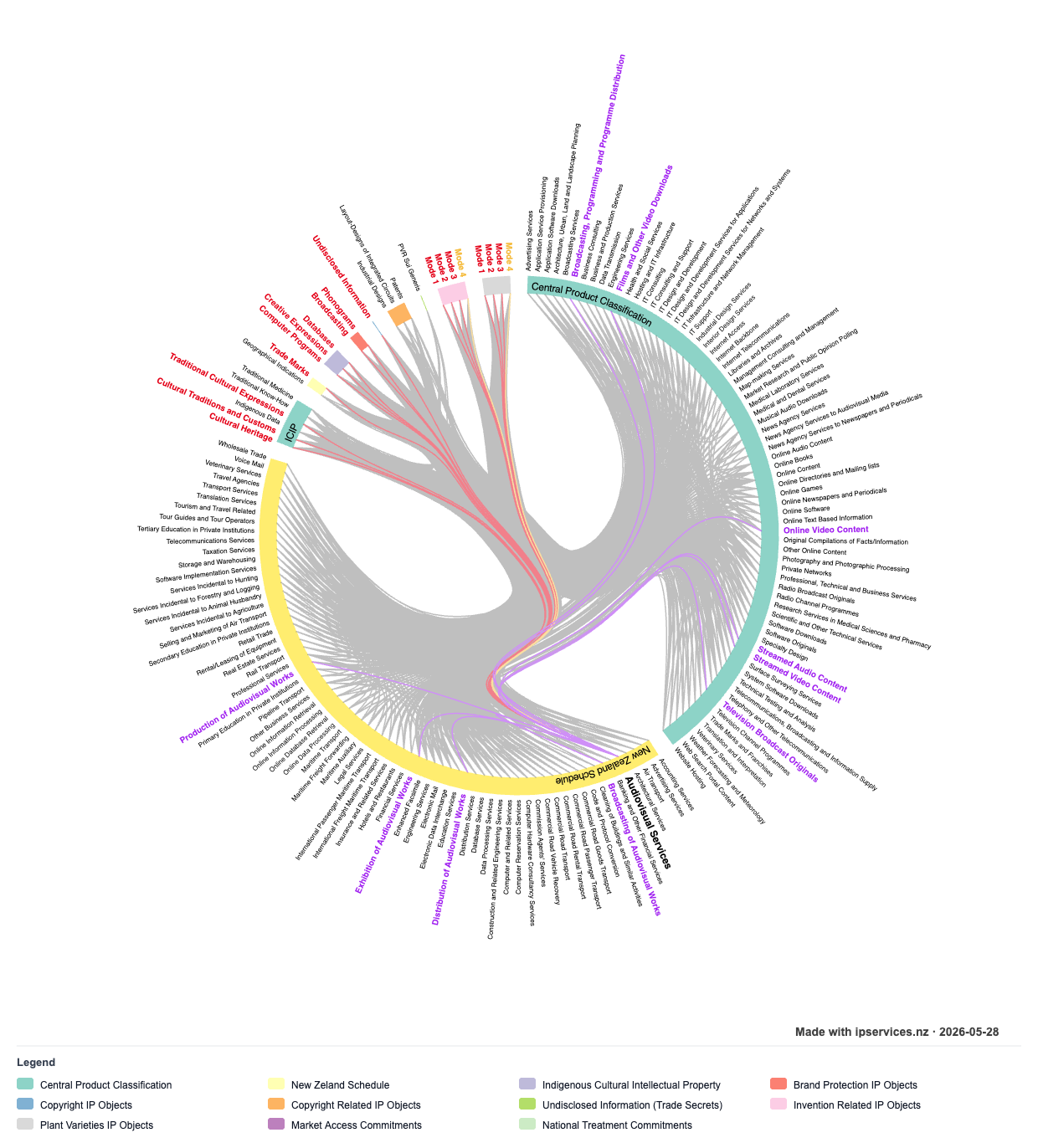
The IP–Services Toolkit maps audiovisual services (2) to four IP asset categories. Creative expressions (film, dramatic and musical works) form the primary link — audiovisual content is fundamentally a copyright product. Phonograms (sound recordings) cover the audio layer, from film soundtracks to streamed music. Broadcasting rights govern transmission to the public for streamed and live content. Computer programs represent the platform layer — the software infrastructure through which content is delivered.
The Central Product Classification ring in the Toolkit shows the specific activities involved: broadcasting and programme distribution, streamed audio and video content, online video content, television broadcast originals, and films and other video downloads — alongside the production, distribution and exhibition of audiovisual works in New Zealand’s GATS schedule. The multi-layered IP stack is characteristic of this sector. A single streamed film may involve copyright in the film, separate rights in the underlying music, a performance right in recorded performances, a phonogram right in the soundtrack and platform-level software copyrights governing the delivery interface.
Seen this way, the Toolkit does more than map categories. It also shows where transactions can stall in practice. The next section turns from structure to interface layers, focusing on recurring interaction problems that shape what firms can actually supply, license and monetise across markets.
3. Interface Layers
Three interface layers matter most here: how rights are split across territories, how licensing shapes access to music and catalogue content, and how platform controls and exceptions affect what users can actually do once the service is delivered. Taken together, these layers explain why audiovisual trade is not just a question of market entry, but of whether the rights needed to make the service commercially usable can be assembled and exercised in practice.
3.1 Territorial exclusivity and release windows
Film and series rights are usually licensed territory by territory. That means a platform can have the legal right to supply audiovisual services in New Zealand, but still not be able to show specific titles if those rights are already committed elsewhere.
This is where windowing, platform-wide exclusives, and holdbacks matter. These are normal commercial tools, but together they can leave a market looking open in the schedule while viewers receive a smaller or later catalogue in practice.[2]
The key interface point is simple: trade commitments open the route to market, but private licensing still controls what can move through that route, when it appears, and on which platform. So entry rights and usable catalogue rights are related, but not the same thing.
In legal terms, this licensing discretion is broadly preserved unless competition concerns are engaged.[3]
3.2 Collective management and blanket licences
Music rights sit inside almost every audiovisual product. So platforms often need licences from studios and distributors plus collecting societies for songs and sound recordings.
New Zealand has collective licensing pathways and a tribunal process for disputes. But once a platform operates across several countries, fee structures, approval processes and timing rules can differ. That makes rights clearance slower, more expensive and less predictable, especially for older catalogue content.[4] On a similar point, copyright tribunal oversight can improve terms where a scheme exists, but it cannot create missing licensing channels or force every rightsholder to deal on workable terms.[5]
The same interface issue affects New Zealand exporters in reverse. A producer or platform supplying offshore may be formally allowed to enter a market, but still face practical barriers in clearing music and related rights on workable terms.
So even where service commitments look liberal, market-by-market licensing practice can still determine whether supplying abroad is commercially realistic.[6]
3.3 Access controls and exceptions for digital delivery
Digital delivery commonly relies on platform access controls. These controls shape what users can do after they have paid for access, and New Zealand law gives them strong protection while keeping exceptions relatively narrow.
In practice, this creates recurring interface problems where delivery technology and user expectations do not line up:
- a subscriber who purchases a film on one platform cannot move it to a competing device ecosystem;
- a critic or educator who needs a short clip for commentary may be blocked by access controls;
- a developer building accessibility tools may be unable to make technically necessary adjustments, even where the end use is socially valuable.
New Zealand's current exceptions framework is narrower than in some trading partners, especially for newer digital uses such as quotation in online formats and text-and-data analysis. That matters for both local users and offshore suppliers serving the New Zealand market.[7]
The commercial effect is cumulative. Legal teams spend more time clearing routine uses, product teams delay features, and smaller suppliers bear a proportionally higher compliance burden than larger firms. The result is usually a thinner and more costly market in practice, and in the worst cases, a de facto market closure.[6:1]
4. Takeaway
New Zealand’s open scheduled commitments for audiovisual services are a starting point. But the analysis in Part III shows that the practical depth of access — the catalogue available, the cost of rights clearance, the range of downstream uses — depends on IP choices the GATS schedule does not address.[6:2]
That two-way pattern is central here. New Zealand’s openness shapes conditions for inbound suppliers and to an extent domestic players, while New Zealand exporters abroad face the same licensing and rights-clearance frictions in reverse, although based on differently structured services schedules and IP legal frameworks.
Coherent trade policy in this area requires one step fuether in acknowledging that the IP-services linkages exist and that the marker access point is the interface between the two. Each IP choice or services regulation might be individually within the bounds of the law; their cumulative effect on market access is what requires policy attention. For an analysis of analogous dynamics in computer and software services, see Study 1.
Statistics New Zealand "Business Operations Survey — IP protection strategies by industry" table BUO021AA (last updated 25 March 2022) https://infoshare.stats.govt.nz. ↩︎
Nikita Melashchenko "Two Regimes, One Market: IP–Services Linkages and New Zealand's Trade Policy" (2025) 56 VUWLR (preprint available at https://doi.org/10.25455/wgtn.31062634), Part IV.B. ↩︎
TRIPS Agreement, art 40; Melashchenko, above n 2, Part IV.B. ↩︎
Cody Rei-Anderson and Susy Frankel "Copyright and Streaming in New Zealand" in Séverine Dusollier (ed) Copyright Law and Streaming: A Comparative Law Analysis of Lawful and Unlawful Streaming Services (Brill, 2025) https://doi.org/10.1163/9789004711525_023 at 575. ↩︎
Susy Frankel and Nikita Melashchenko "Collective Management and the Copyright Tribunals of New Zealand and Australia" in Daniel Gervais and João Pedro Quintais (eds) Collective Management of Copyright and Related Rights (4th ed, Wolters Kluwer, Netherlands, 2025) 543 (preprint available at https://doi.org/10.25455/wgtn.31052737) at 553–555. ↩︎
Melashchenko, above n 2, Part IV.B; Rei-Anderson and Frankel, above n 4, at 575–581. ↩︎ ↩︎ ↩︎
Rei-Anderson and Frankel, above n 4, at 580–581; Melashchenko, above n 2, Part IV.B. ↩︎