This part sets out the analytical approach behind the IP–services linkages chart. It explains the four assumptions on which the analysis rests, describes how the linkages were identified and coded, and shows how to read the chart.
1. The Problem of Two Separate Frameworks
New Zealand's trade commitments on services sit in the General Agreement on Trade in Services (GATS)[1] and in the services and digital trade chapters of its free trade agreements (FTAs). IP protection is governed separately, primarily by the Agreement on Trade-Related Aspects of Intellectual Property Rights (TRIPS Agreement)[2] and the IP chapters of those same FTAs.
In practice, many services depend on IP. A software service depends on copyright and, in some jurisdictions, patents. A streaming service depends on copyright licences. A data analytics service depends on permissions to process and mine data. When IP rules affect whether, how or at what cost a service can be supplied, those rules become relevant to trade policy — even if they do not appear in any services chapter.
The challenge is that neither framework explicitly addresses the other. The GATS is silent on how IP rules should be read when they condition services supply. The TRIPS Agreement is silent on how IP standards interact with services commitments. This project maps where the two frameworks meet.
From a regulatory standpoint — in the sense developed by the New Zealand Law Foundation Regulatory Reform Project at New Zealand Centre of International Economic Law (NZCIEL) — both the GATS and the TRIPS Agreement are best understood as regulatory instruments that shape market behaviour. That project's analysis of international commitments as structural constraints on domestic regulatory space, and its account of the loop by which regulatory change in one system propagates through to others, provides the conceptual vocabulary for understanding IP and services rules as functional conditions on services (and digital) trade rather than as merely parallel obligations in a separate chapter.[3]
2. Assumptions
The analysis rests on four assumptions. Each is grounded in the text and purpose of the relevant frameworks. Together they define the conditions under which the chart's linkages are meaningful.
Assumption 1: FTAs build on WTO rules, not against them. New Zealand's FTAs are structured as extensions of WTO disciplines. IP and services obligations in FTAs should be read consistently with the GATS and the TRIPS Agreement, not in isolation from them.
Assumption 2: GATS commitments apply only where a sector has been scheduled. Under the GATS positive-list system, market access and national treatment obligations apply only in sectors where a WTO Member has made specific commitments. New Zealand's Schedule of Specific Commitments is the starting point.
Assumption 3: TRIPS Agreement is designed to benefit both rights-holders and users. Article 7 of the TRIPS Agreement states that IP protection should promote innovation and the transfer of technology "to the mutual advantage of producers and users of technological knowledge." IP rules are not solely about protection — they are also about enabling access and use.
Assumption 4: New Zealand's IP policy is designed to support innovation, not create market barriers. New Zealand's approach to IP seeks to balance protection for creators with access for users and competitors. Where IP rules restrict services supply, the analysis treats this as likely unintended rather than a deliberate policy choice.
3. How the Linkages Were Identified
3.1. Starting on paper
The project began with a simple question written on paper: for each services sector in New Zealand's GATS Schedule, which IP rights does a supplier need to hold, license, or manage in order to operate? The answer was different for a computer services company than for a broadcasting firm or a tourism operator, and the differences were not obvious from the texts of either the GATS or the TRIPS Agreement alone.
The initial mapping was done as a matrix — services on one axis, IP types on the other — drawn by hand and then structured in Visio to make the relationships visible at a glance. This exercise identified the IP–services pairs that were worth examining in depth and those that were unlikely to be relevant.
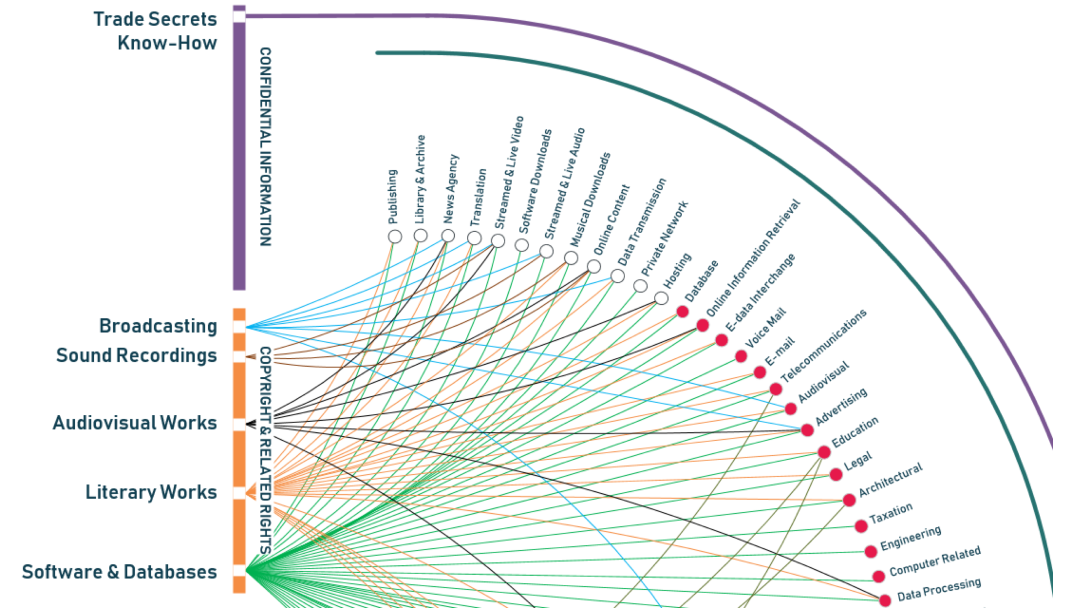
The initial matrix: services on one axis, IP types on the other, drawn before the correlations were recorded in a database.
The mapping exercise also made clear that the two separate regulatory regimes — GATS-based liberalisation and TRIPS-based IP protection — operate on different legal instruments but converge on the same economic transaction: the supply of a service that depends on an IP-protected asset. These insights were developed and tested through the project's early research, leading to several workshops held for the New Zealand Pacific Economic Cooperation Council (NZPECC). The workshop materials (reproduced and available for donwload below) show the analytical framework as it stood at that stage.
(a) The general correlations map
The first stage introduced the general correlations map. It was the initial digital rendering of the paper matrix together with the methodology that underpinned it.
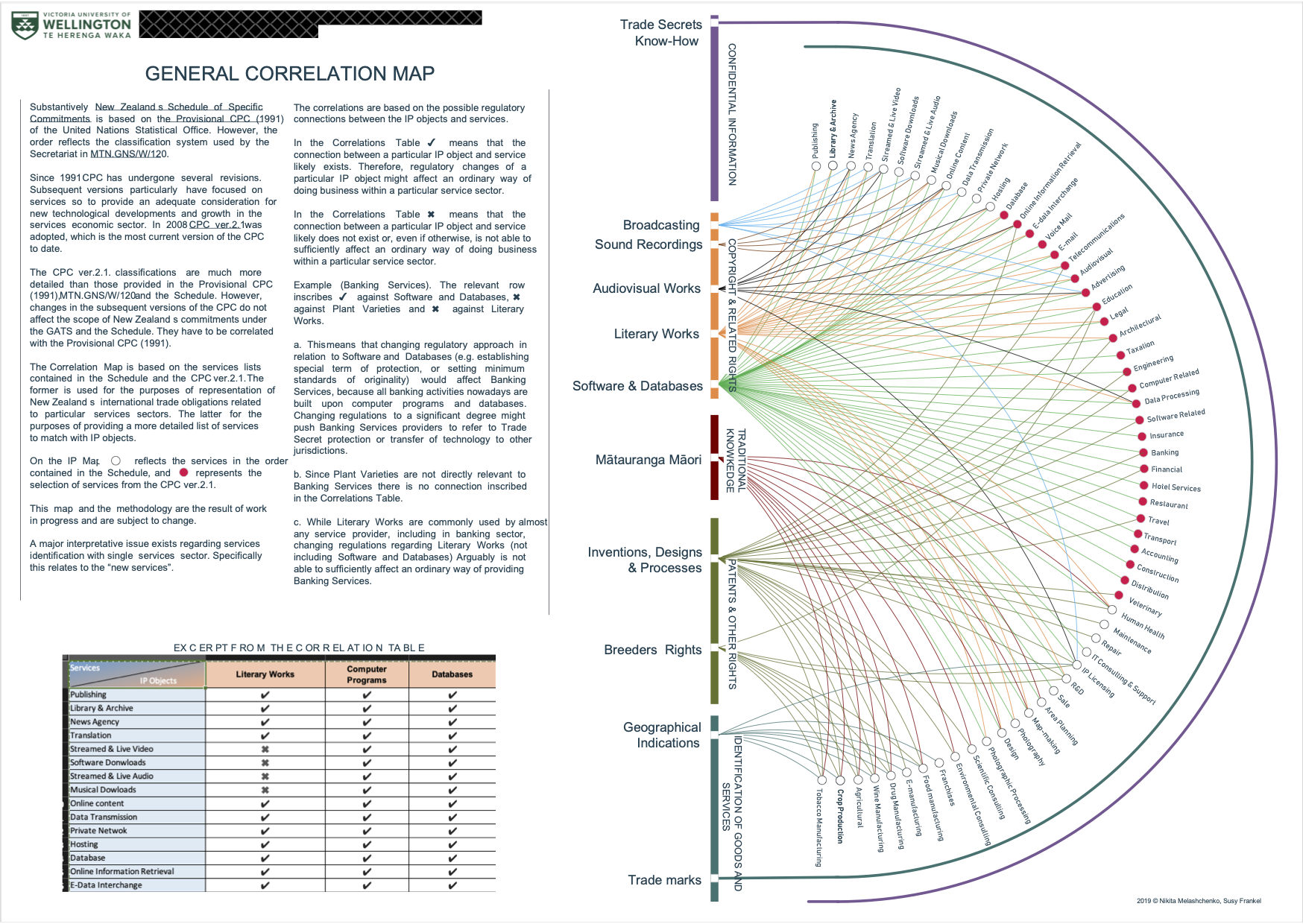
New Zealand's Schedule of Specific Commitments is based on the Provisional CPC (1991); subsequent CPC revisions — culminating in CPC v2.1 (2008) — provided much more granular service categories against which IP types could be matched. The map was built from both lists: the Schedule for New Zealand's actual international trade obligations, and CPC v2.1 for the more detailed service categories. Open circles represent services in the Schedule; filled circles represent services drawn from CPC v2.1.
The correlation logic was binary: a ✓ in the table means that regulatory changes to that IP type would likely affect an ordinary way of doing business within that service sector; a ✗ means the connection likely does not exist or, even if it does, is insufficient to materially affect service supply. The example used in the handout — Banking Services — illustrates the selectivity the method requires. Banking is built upon computer programs and databases (✓ Software & Databases); plant varieties are simply not relevant to banking (✗ Plant Varieties); and while literary works are used by almost any service provider, changing rules on literary works distinct from software — say, term extension for written works — would not be sufficient to materially affect banking as a service sector (✗ Literary Works).
The network diagram on the right of the page is the direct precursor of the IP–Services Toolkit. At this stage colour-coding was not yet applied, but the grouped IP categories — Copyright & Related Rights, Confidential Information, Traditional Knowledge, Patents & Other Rights, Identification of Goods & Services — and the outer ring of services already establish the visual logic that the later chart refines.
(b) Case examples: services in practice
The second stage applied the map to three sectors, testing whether the matrix held up against real service supply patterns.
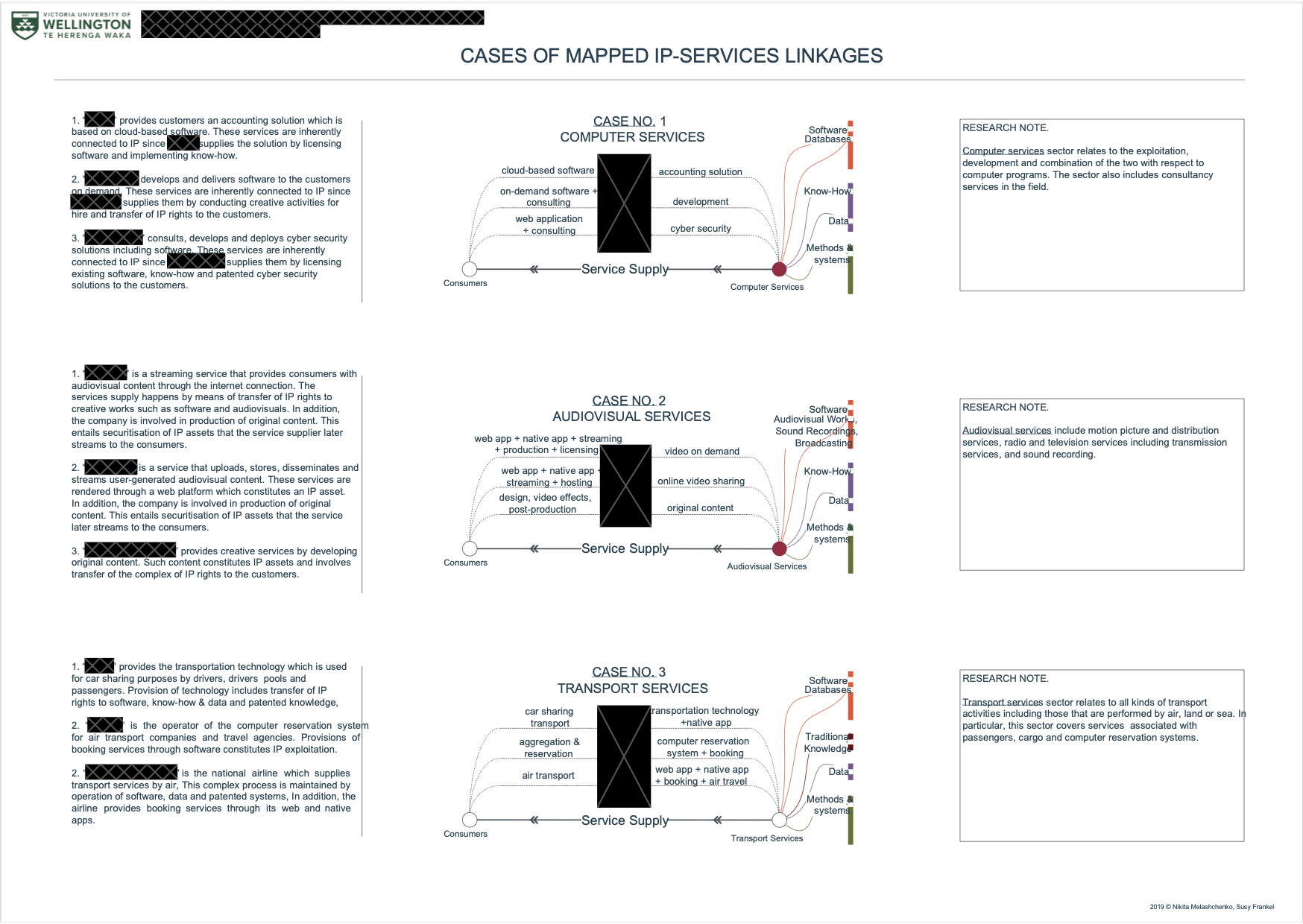
Computer services, audiovisual services and transport services were examined as proof of concept. Each case was structured around the same supply-chain diagram: consumers on the left, a service supply arrow running towards the right, the sector node at its tip, and the relevant IP types arranged as bars on the far right. The diagram made visible something the text of the GATS and TRIPS Agreement alone cannot show — that IP dependency is not simply a matter of which sector a service belongs to, but of the specific actions involved in supplying it.
Computer services required software and databases as an input, know-how as a condition of supply, and methods and systems as the underlying architecture. Audiovisual services drew on a wider set — software, audiovisual works, sound recordings and broadcasting, know-how, data — reflecting the layered IP stack involved in producing, streaming and distributing content. Transport services, despite appearing technologically lighter, connected to software and databases through booking and operational platforms, to traditional knowledge (a connection developed further in the tourism and travel case study), and to data and methods through reservation and scheduling systems.
The diagram structure across all three cases established the template for the full questionnaire. If these dependencies could be identified sector by sector, they could be assessed systematically across the entire Schedule.
(c) From dependency to framework
The third stage set out the theoretical basis for the supply-chain diagrams and the correlation logic.
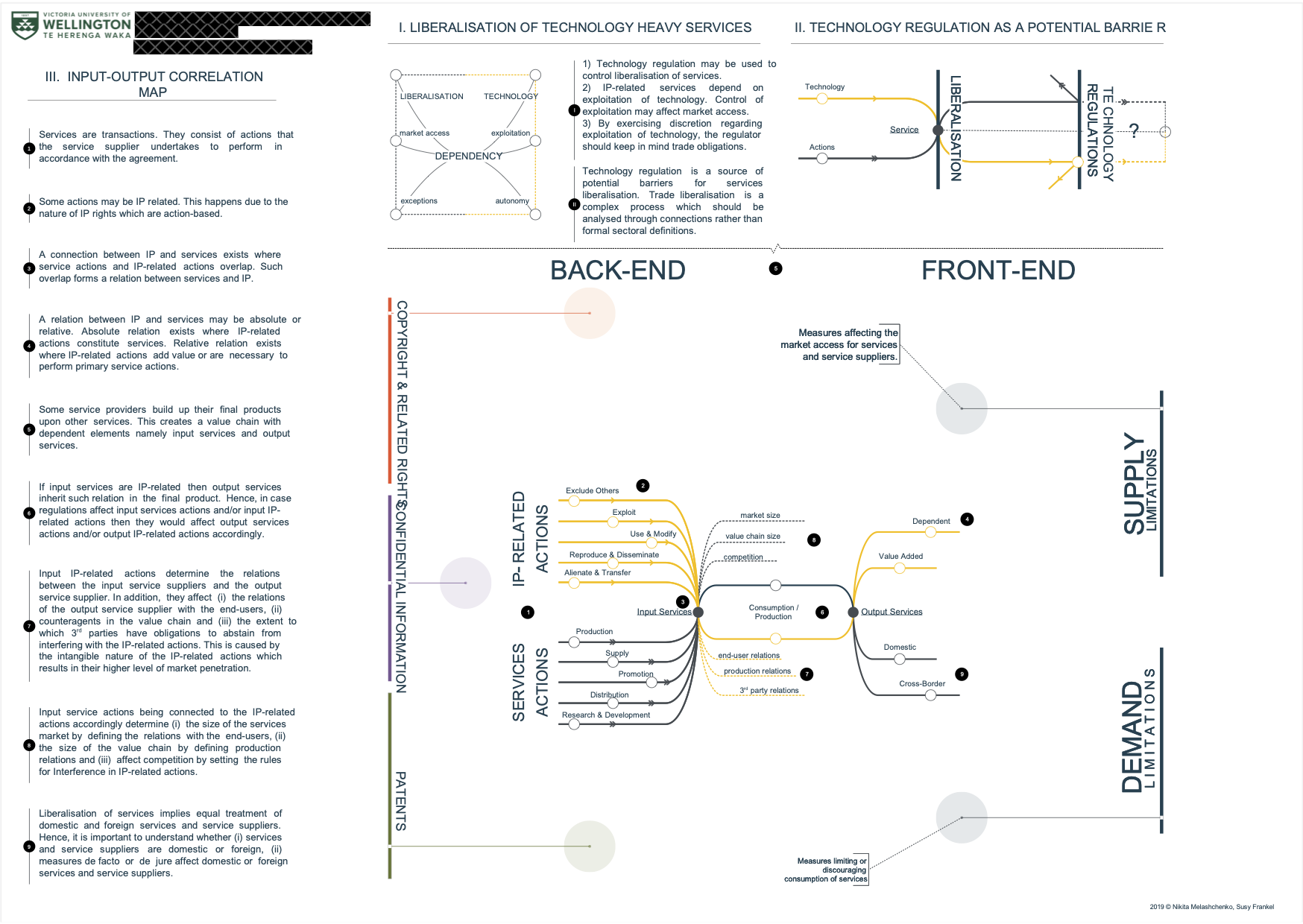
Nine propositions built from a foundational observation that services are transactions, consisting of actions a service supplier undertakes to perform, towards a policy conclusion about regulatory coherence. Because IP rights are action-based (each right confers specific powers to exclude, exploit, modify, reproduce, or transfer), some service actions are necessarily IP-related. Where IP-related actions and services actions overlap, a dependency exists. That dependency may be absolute — where the IP-related action constitutes the service — or relative — where it is a necessary condition or value-addition to the primary service action. When input services are IP-related, output services inherit that relation through the value chain, and any change to the IP framework affects the output services accordingly.
The framework distinguished two zones of regulatory impact. The back-end — IP exploitation and control — is governed by the TRIPS Agreement and its equivalents. It determines who can produce, license or restrict the underlying IP asset. The front-end — liberalisation — is governed by the GATS. It determines the conditions under which a service can enter and compete in a market. Supply limitations (foreign capital rules, licensing requirements, procurement restrictions) and demand limitations (measures affecting market access or discouraging consumption) operate at the margins of both zones simultaneously. Where a service depends on IP, any measure touching the back-end can, in effect, condition the front-end.[4]
The zone of intersection — where GATS liberalisation and TRIPS technology controls converge — was labelled dependency. The diagram below renders this structure in its simplest form:
The four quadrants name distinct regulatory concerns:
- Market access: the conditions under which a foreign service or supplier may enter — is the primary subject of the GATS;
- Exceptions: general and security exceptions together with scheduled limitations on commitments — permit departures from those conditions;
- Exploitation: on the IP side, captures the commercial rights that the TRIPS Agreement secures for IP holders (and these vary);[5]
- Autonomy: captures the freedom IP holders retain to refuse to license or deal.
A dependency forces these four zones into relation. A change in exploitation terms (TRIPS side) may effectively condition market access (GATS side), without any direct measure targeting services.
The full input-output structure — IP-related actions and services actions converging on the point of supply, producing dependent or value-added outputs distributed domestically or cross-border — was represented as follows:
(d) Research questions and input-output analysis
The fourth page translated the framework into a structured set of research questions and applied them to a detailed sector case.
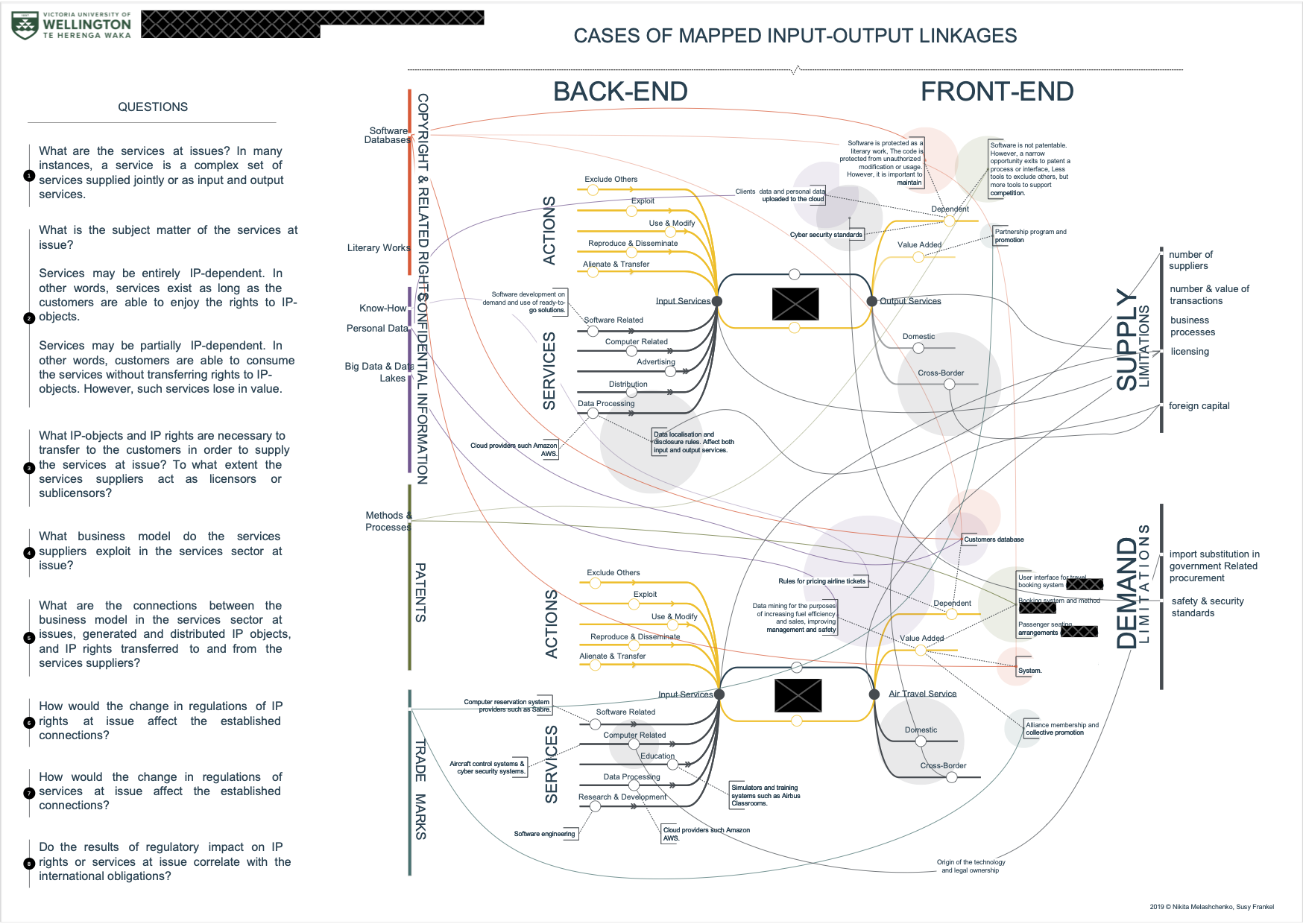
Seven questions organised the detailed analysis. The first three concern identification. What are the services at issue (recognising that a service is often a complex bundle of input and output services)? What is the subject matter of those services (entirely IP-dependent, where the customer enjoys rights to an IP object, or partially IP-dependent, where IP adds value but the service can be consumed without a rights transfer)? And what IP assets and rights must be transferred or licensed for the service to be supplied? The fourth question asks about business model — how the service sector is structured commercially? The fifth and sixth trace the connections between the business model, the IP assets generated or distributed, and the rights transferred to and from service suppliers, then ask how changes to IP or services regulations would affect those connections. The seventh asks whether those regulatory effects would be consistent with New Zealand's international obligations.
The case illustrated how copyright (protecting software as a literary work), patents (covering booking systems, passenger seating arrangements and user interfaces), trade secrets (know-how and personal data held in cloud infrastructure) and trade marks (embedded in partnership and alliance networks) all operate simultaneously on a single complex service. Supply limitations — foreign capital restrictions, data localisation requirements, disclosure rules — and demand limitations — government procurement rules, safety and security standards — affect input and output services across both domestic and cross-border supply channels.
These questions and the conceptual distinctions they rest on, became the foundation of the structured questionnaire described next.
3.2. Assessing each linkage: the questionnaire
The visual map raised the next question: how strong is each linkage? A link between "computer services" and "software copyright" is clearly significant. A link between "transport services" and "geographical indications" is not. To assess strength consistently across all IP types and all service categories, a structured questionnaire was designed.
The questionnaire has three sections. Sections A and B assess whether the IP right matters as an input to delivering the service and as an output that the service produces. Section C combines the two scores into an overall dependency rating.
Each answer carries a point value. The A and B scores (each ranging from 2 to 6) and the C1 comparison score (1 to 3) are summed to give a total between 3 and 15. The overall C2 rating — 🔴 High (11–15), 🟡 Moderate (6–10), or 🔵 Not Dependent (3–5) — captures how much this IP type matters for this service category.
The questionnaire was applied to 13 IP-related categories examined in this study largely coming from the TRIPS Agreement and New Zealand's IP legislation — computer programs, creative expressions, databases, phonograms, broadcasting signals, patents, industrial designs, integrated circuit layouts, plant variety rights, trade marks, geographical indications, trade secrets and traditional knowledge — across every service category in New Zealand's GATS Schedule and the UN Central Product Classification (CPC v2.1).
3.3. Recording results on a spreadsheet
Each IP type has its own table in the research database. Each table has 169 rows — one for each service category drawn from New Zealand's GATS Schedule of Specific Commitments and from the broader CPC v2.1 classification. Together the 13 tables hold 2,197 individual assessments.
The explorer below presents all results in one place. Select a view from the dropdown: Matrix shows a single cross-IP table (one row per service, 13 emoji columns); the named IP type tabs show the full questionnaire detail for that IP asset; Definitions lists terms of reference used in the questionnaire, including software titles and company examples; and Statistics shows StatsNZ data on IP use by sector and year discussed in Part II. Services appear in the order of the source data — NZ Schedule entries followed by CPC entries, each in the sequence of the original classification document. A standalone searchable CPCProv reference table with descriptions, produced as a side product of this research, is available separately on Observable.
3.4. From a database to a map
The individual assessments on a spreadsheet produce a large number of data points, but the real question for trade policy is about patterns. Which sectors depend most heavily on IP assets? Which IP types cut across the widest range of services — creating the greatest potential for regulatory friction or policy leverage? The IP–Services Toolkit below makes those structural relationships visible at a glance.
Each arc segment on the rim is a node — a services sector, an IP type, or a GATS mode of supply. Each curved line connecting two nodes is a dependency linkage. Hover any node to reveal any reference information; lines are colour-coded by the strength of the dependency: red for High, amber for Moderate, and purple where horizontal relations exist. Click any node to open its research page – some may contain more information than others. The full chart — with legend, export and full-screen mode — is at the IP–Services Toolkit dedicated page.
Each line colour directly reflects the C2 rating from the questionnaire in Section 3.2. Red (🔴) means a total score of 11–15: the IP right is structurally significant for the supply of that service — a change to the IP framework would likely have direct consequences for market access or national treatment obligations. Amber (🌕) with a score 6–10 indicates a material but less integral connection. Purple marks horizontal relationships, for instance, between services sectors and IP types. Linkages rated Not Dependent (🔵)are not shown; those nodes appear on the rim but have no connecting lines.
Importanly, this scoring is qualitative and reflects the research team's best judgement based on the questionnaire. It is not a quantitative measure of economic value or trade volume. The goal is to identify where IP rules are likely to have the most significant impact on services trade, not to assign a precise numerical value to that impact. Tables and the chart are tools for visualising patterns and guiding further analysis, not a definitive ranking of importance.
The density of lines at any given node gives an immediate read on exposure. A services sector massed with red lines depends on multiple IP types as structural inputs or outputs. This is a natural starting point for any policy review. An IP type with many red lines materially conditions a wide range of services trade obligations across the Schedule.
4. How to Read the Chart
The lines in the Toolkit are not evenly distributed. Some sectors — computer and software services, audiovisual and streaming — connect to most IP types at high intensity. Others — transport, construction, some health services — show lighter, more selective connections. That asymmetry identifies where IP rules are most likely to act as structural conditions on services trade, and where regulation in either framework would have the widest knock-on effects.
Two structural patterns are worth looking for. The first is a services sector with many red connections. An IP-intensive service whose supply depends on holding, licensing or managing multiple IP rights simultaneously. Computer software sits at the intersection of copyright, trade secrets, database rights, and — in some jurisdictions — patents. The second pattern is an IP type with many red connections. A systemic right that conditions a wide range of services supply. Copyright is the clearest example, appearing as a high-dependency input across sectors from streaming to data analytics to professional consulting.
The four case studies in Part IV examine sectors with the highest density of high-intensity connections. Study 1 (Computer and Software Related Services) and Study 2 (Audiovisual and Streaming Services) examine copyright-intensive sectors where the link between IP obligations and services commitments is direct and commercially significant. Study 3 (Tourism and Travel Services) and Study 4 (Human Health Services) examine sectors where the connections are less immediately visible but no less consequential — geographical indications and traditional knowledge in tourism; patents and trade secrets in health.
Recent New Zealand-focused scholarship on streaming and collective management supports this interface framing, showing that content availability, licensing architecture and institutional oversight often determine practical market access more than formal schedule language alone.[6]
The IP–Services Toolkit identifies where to look, not whether any particular rule is legally consistent with another. It maps the terrain on which those questions arise.
General Agreement on Trade in Services, WTO Agreement 1867 UNTS 187 (signed 15 April 1994, entered into force 1 January 1995) [GATS]. ↩︎
Agreement on Trade-Related Aspects of Intellectual Property Rights (signed 15 April 1994, entered into force 1 January 1995) [TRIPS Agreement]. ↩︎
Susy Frankel et al "Regulatory Reform Toolkit" (2013, New Zealand Centre of International Economic Law) https://www.regulatorytoolkit.ac.nz/. ↩︎
Nikita Melashchenko "Two Regimes, One Market: IP–Services Linkages and New Zealand's Trade Policy" (2025) 56 VUWLR (preprint available at https://doi.org/10.25455/wgtn.31062634) [Melashchenko 2025] at Part III. ↩︎
Melashchenko 2025, above n 4, at Part III.A, ss 4–5 (on the right to authorise as the legal bridge for licensed services supply and the coordination of exceptions and necessity tests; the exploitation and autonomy quadrants correspond to the scope of exclusive rights and the IP holder's freedom to withhold licensing as discussed there). ↩︎
Cody Rei-Anderson and Susy Frankel "Copyright and Streaming in New Zealand" in Séverine Dusollier (ed) Copyright Law and Streaming: A Comparative Law Analysis of Lawful and Unlawful Streaming Services (Brill, 2025) https://doi.org/10.1163/9789004711525_023; Susy Frankel and Nikita Melashchenko "Collective Management and the Copyright Tribunals of New Zealand and Australia" in Daniel Gervais and João Pedro Quintais (eds) Collective Management of Copyright and Related Rights (4th ed, Wolters Kluwer, Netherlands, 2025) 543 (preprint available at https://doi.org/10.25455/wgtn.31052737). ↩︎